

Foaling in horses is an important event in breeding operations. The pregnancy period of mares is 320 to 345 days, with an average of 330 days. The mare foals typically at night, and the entire process lasts for only 2-3 hours. The foaling in mares is a sequential process, and it happens one after another. The problems in foaling may lead to a significant loss in horse breeding farms. The mares take considerable time and care from heat detection, breeding, covering, and care of pregnant mares. If an accident occurs in parturition, the foal may die, and the mare becomes anestrous for the next breeding season.
Essential Aspects of Horse Foaling
Parturition, or the giving birth of a horse foal, is a complex and sequential event. The mare shows signs of parturition at the later stage of pregnancy. You must take the mare to the parturition box or stable from the pregnant paddock as early as possible. The mare normally foals at night; that’s why you must be more cautious about the event.
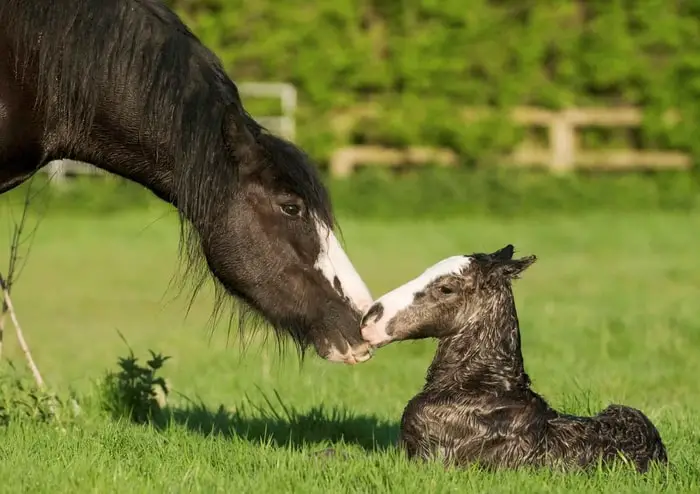
Endocrine Control of Foaling in Mares
- Parturition is rapid in mares, and the endocrine control is poorly understood.
- Unlike other species like cows, parturition is preceded by a decrease in circulating estrogen concentration and progesterone.
- Prostaglandin, oxytocin, relaxin, and corticosteroids are probably involved.
- The role of the prolactin hormone is unknown.
- Placental lactogen hormone is not found in mares.
Preparation of the Environment for Horse Foaling
- Constant surveillance is difficult.
- Other horses may molest the foal.
- The fetal membrane may be predated before the inspection.
- The foal may be damaged by wire and hedges, or fall into ponds and ditches, etc.
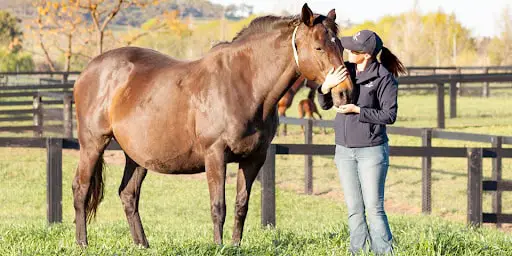
Mare Foaling Box Requirement
- Adequate room, at least 12 feet by 12 feet.
- Minimal disturbance.
- Good bedding is well compacted over a concrete floor and built up against the wall.
- Minimal low-level feed bins and water buckets should be off the floor.
- It requires lots of time and patience.
- In the event of a mare not foaling at the expected time, the veterinary surgeon may be called for.
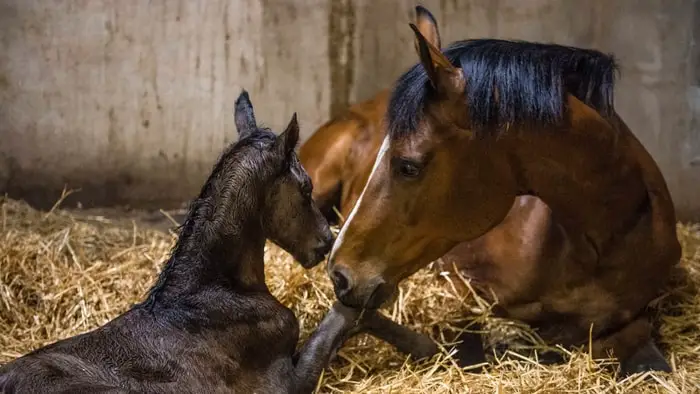
- Examine the mare per rectum to confirm that she is pregnant.
- Confirm, by feeling the fetal movement, that the foal is alive.
- Confirm if the palpation of the foal’s head is possible and that it is an anterior presentation.
- Possibly, examine the cervix per vaginum for evidence of relaxation and liquefaction of cervical mucus. The cervix in late pregnancy is usually very soft, and the canal is only 11-12 cm long. The fetus is often palpable per vaginum.
- Check that the expected date of parturition has been calculated correctly.
First Signs of Horse Foaling
- The beginning of the first stage can not be recognized.
- This is the preparation for the expulsive stage.
- The mare is restless, looks at her flanks, and shifts her weight from one hind limb to another.
- Slackening of the sacro-sciatic ligaments and relaxation of the vulva are inconsistent signs.
- The escape of a honey-like precursor of colostrum onto the ends of the teats is a good sign that the mare is in the first stage, but some mares expel obvious milk for days before foaling, and others never wax up.
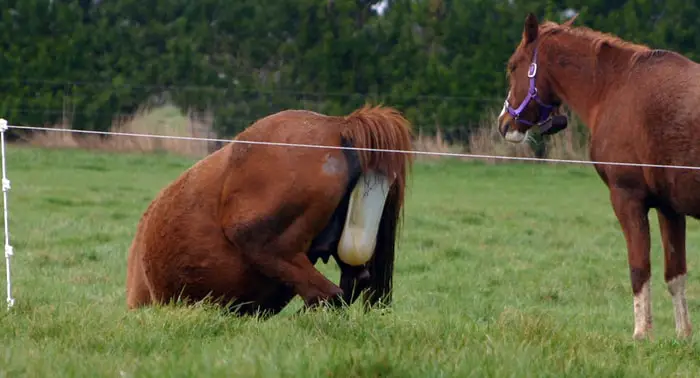
- There is a rise in the calcium and potassium content of udder secretion before foaling and a fall in sodium; the concentrations of potassium and sodium become similar.
- The signs of first-stage labor are those exhibited by a mare suffering from myometrial contractions before the opening of the cervix.
- The intensity of the signs of parturition depends on the mare and her environment.
- Mares in first-stage labor may hold their breath and grunt, but they generally do not strain. This is explosive and expulsive and occurs during the second stage.
Second Stage of Parturition in Mares
- The cervix opens relatively quickly to allow the separating chorioallantoic membrane (CAM) to bulge into the birth canal.
- Eventually, the pressure in the birth canal causes either the CAM to rupture, with the visible loss of allantoic fluid from the vulva, or the mare to strain.
- Either event marks the beginning of the second stage of labor and has evoked Ferguson’s reflex; birth canal distention causes oxytocin release and further myometrial contractions if the CAM hasn’t ruptured.
- Mare is usually in lateral recumbency.
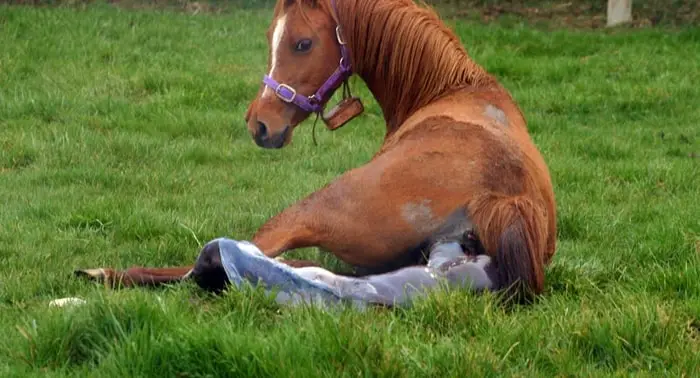
- Straining involves tensing of the abdominal muscles and rigidity of all four limbs.
- The amnion, a glistening white membrane, soon becomes visible at the vulva, containing fluid and the fetal foot.
- Both front feet and nose should appear in quick succession.
- After the expulsion of the head, the mare often stands and eats or may roll to change the foal’s position.
- Further straining ensures delivery to the chest and hips.
- If left undisturbed, the mare may lie for some time with the foal’s hind limbs in her uterus.
- The foal is born with the amnion but ruptures this when it attempts to sit up.
- Movement of the dam or foal causes the umbilical cord to rupture close to the abdominal wall.
- The mare’s instinct is to lick the foal dry, but not to eat the membranes.
- Second-stage labor usually occurs at night and lasts 5-25 minutes.
Third Stage of Foaling in Horses
- This stage usually occurs within three hours.
- Mares may show signs of abdominal pain due to continued uterine contractions.
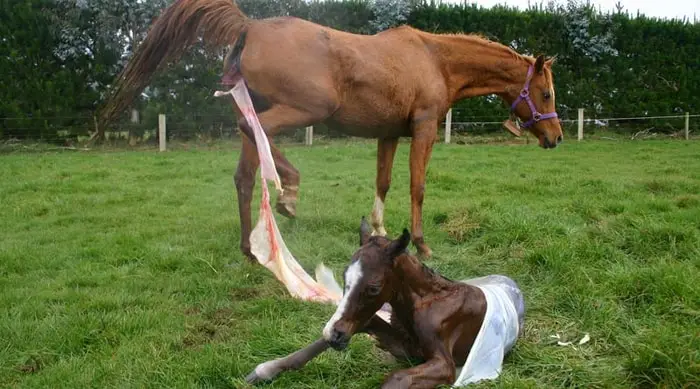
- The weight of the amnion gently pulls the CAM via the umbilical cord, causing separation.
- The CAM is turned inside out during expulsion.
- The membranes should be kept and inspected to ensure that they are complete.
Induction of Parturition in Mares
Induction of parturition or foaling is rarely necessary because long pregnancies are physiological, and large fetal size is not a problem. The induction of parturition is functional in an uncomfortable mare running milk with ventral edema and relaxation of the cervix. The induction of foaling should be done after 320 days of pregnancy, the mammary glands should be well developed, and the veterinarian should be consulted. The following drugs can be used for the induction of parturition in mares:
- Estradiol @ 5-10 mg 24 hours before the relaxation of the cervix.
- Prostaglandin at twice the luteolytic dose.
- Oxytocin at 40-60 IU intravenously.
Final Advice on Parturition of Mare
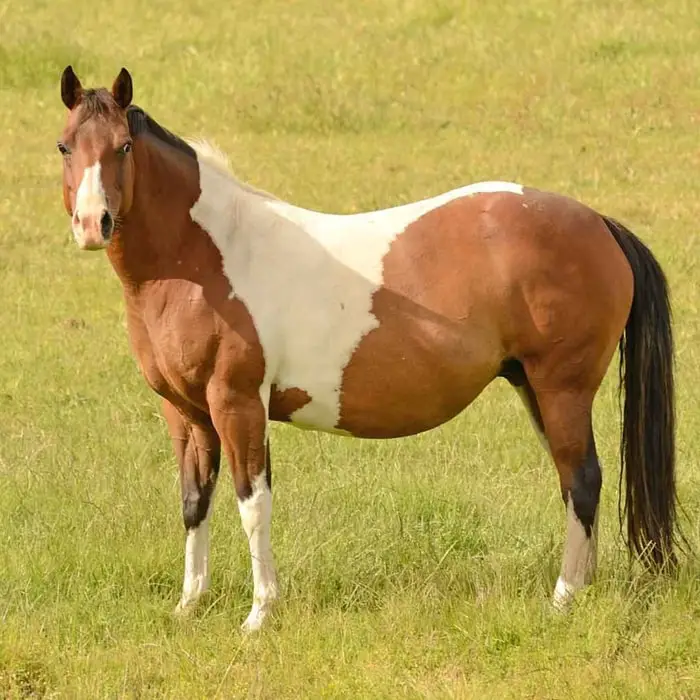
Foaling is one of the most important and last events of horse reproduction. A few problems arise during foaling, like dystocia, stillbirth, and weak foals. The conditions require surgical and clinical treatment. Improper management and unskilled personnel should not be kept at the parturition stable.
